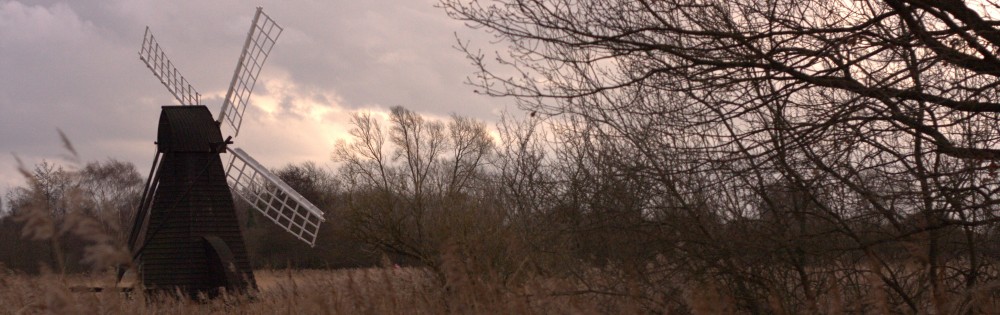
Taken at the Flood

In southern England, January 2014 was the wettest since records began (the 1760s in the case of the Oxford Radcliffe Observatory).  Thousands of homes have been flooded, and large parts of the Somerset Levels have sat under water for weeks.  In a week of storms (‘stormageddon’, announced the Daily Mirror), a stretch of the sea wall at Dawlish in Devon was destroyed, cutting the only rail route to Plymouth and Cornwall. The Environment Agency was accused of ‘putting birds before humans‘.   In the Daily Mail, the Environment Agency was likewise accused of favouring conservation by failing to dredge Somerset rivers ‘and then spending £20m on bird sanctuaries’.

These headlines are perhaps no worse than we have come to expect from public debate about the environment in the UK, driven, as they are, by a combination of ignorance and outrage.  Indeed, by some standards they are quite sensible. A councillor for Henley–on-Thames (from the UK Independence Party), blamed the storms and floods on an act of God because of legislation to legalise gay marriage.   Meanwhile, The destruction caused by floods and storms have triggered that favourite British sport of pass-the-blame: victims blame the government for not doing more, the Local Government Minister blames the Environment Agency, whose Chairman replies by accusing politicians of ‘playing politics’ with the crisis, and for cutting his organisation’s staff. Continue reading

Community-based monitoring for science, management and local empowerment. A flash in the pan?

Citizen Science – research conducted in whole or in part by non-professional scientists – seems to be everywhere at the moment; from our back gardens to remote tropical forests, on our TVs and in our academic journals. It offers something for everyone: scientists like its potential to generate lots of data at low cost; sociologists like the way it changes the relationship between science and the public; the media like its ability to connect with individuals and their personal stories. There are concerns about the quality of data collected by amateur citizen scientists, but there is increasing evidence that they can be of comparable quality to professionals, if those collecting them receive the right training. Citizen Science has been used to look for climate patterns in historical weather records, to unlock the secrets of faraway galaxies, and to map the sacred sites of Congolese forest people. Conservation has been quick to jump on the bandwagon, with a whole range of applications, from detecting bats to identifying new species.

Citizen Science is not one thing, and typologies have been developed that recognise the different roles of citizens in the process (e.g. as passive participants or as active owners of the research) and the varied nature of the tasks performed by citizen scientists (e.g. as ‘sensors’ making observations or as problem solvers). Perhaps the most profound distinction is between individuals who participate in citizen science for pleasure as a hobby, and those for whom the findings have direct implications for their underlying wellbeing. The former category typically involves relatively wealthy people in developing countries (such as expert amateur birdwatchers) whereas the latter category is particularly relevant to conservation in developing countries, where many people depend on natural resources for their livelihoods.

Conservation citizen science in developing countries – often called ‘community-based monitoring’ – is growing in popularity. It has the potential, in theory, to create a fantastic win-win-win. Local people collect data on wildlife and resource use that are highly valuable to conservation and conservation science: win one. These data can then be fed into management of the same natural resources, creating improved long-term conservation outcomes: win two. At the same time, the process of involving local people in study design, data collection and (sometimes) management is empowering, which can create meaningful improvements in wellbeing for local people: win three. There is a real buzz at the moment about the potential of local citizen science to deliver this triple-win, but how robust is it in the face of changing conditions? In particular, to what extent is it dependent on the limitations of current technology? Continue reading

Peeling the onion: how deep should conservation go?

Conservationists and their organisations are often accused of treating symptoms and not causes – as Bill Adams said on this blog a few weeks ago, “mopping nature’s wounds not addressing the cause of injury”. Bill was talking about the big global challenges of conservation, but this problem applies equally at the day-to-day level. The park staff have no equipment? Buy them some from a grant, and don’t worry about where the replacements will come from. The government counterpart is corrupt? Work with him or her anyway, because they can get things done in the next few months. And so it goes on.

Conservation researchers in general, and political ecologists in particular, like to look deeper, unravelling the chains of explanation that get to the processes that underpin emergent threats. They (we) often argue that by applying short-term sticking plasters, conservation isn’t really making much difference for the long term, and that more conservation effort should go to addressing deeper underlying problems. In other words, (and mixing metaphors) conservation should make more effort to peel back the layers of the onion, to see what lies beneath. Continue reading

The Power of Evidence

It is hugely reassuring to suggest that decisions should be evidence-based. It sounds safe, sane, sensible. It seems self-evidently right. What else could they be based on? Guesswork? Hope? Prejudice? As a result the concept of evidence-based policy is on the ascendancy everywhere. Politicians love it, because it sounds so reasonable. Policy makers love it because it implies that decisions can be rational, free of bias, proofed against sectional interest. Scientists love it because it offers the opportunity to feed ‘sound science’ into the ears of policy-makers. So it seems an obvious fact that evidence-based policy is a good thing: yet as Sherlock Holmes comments in The Boscombe Valley Mystery ‘there is nothing more deceptive than an obvious fact’. Some caution may be warranted, for there are deceptive layers hidden by the term that are easily overlooked. Continue reading

Tigers or Transition?

Is biodiversity conservation part of the environmental movement? To what extent is the protection of species like tigers an integral part of wider concerns about transition to more sustainable lives on earth?  These questions came up at a recent meeting Conservation and Sustainability: Do We Practise What We Preach?, organised by the Cambridge Conservation Forum. The questions are simple enough.  The answers turn out to be a bit more complicated.

Historically, it’s a no-brainer.  The birth of the modern conservation movement in the late Nineteenth Century was strongly environmentalist, in that it was a broad-spectrum reaction to the depredations of capitalism and industrialism. In colonised territories like North America or Africa, the extinction of species (blaubok, quagga or passenger pigeon) and the settlement of frontiers drove a wave of sentiment for wilderness.  Yet in countries like the UK, conservation had broader roots: the founders of organisations like the National Trust and the RSPB and the Open Spaces Society were people who opposed the impacts of industrial pollution, urban sprawl, hunting and collecting, even if they enjoyed certain of its fruits.

Continue reading

Conservation and capitalism: on your Marx, get set, GO!

I recently attended a conference at the University of Toronto entitled “Grabbing ‘Green’: Questioning the Green Economy”. This was part of a series of linked conferences held over the past few years that bring together scholars who critically analyse the relations between biodiversity conservation and neoliberal processes such as commodification, marketisation and privatisation. Academics working in this field have identified various problems with so-called ‘neoliberal conservation’, as reviewed by Buscher et al 2012. Over the last few years I have enjoyed getting to know this literature, and more recently I have enjoyed getting to know personally some of its leading authors. I think that they have identified deep and serious problems with the neoliberal turn in conservation. At the same time, I have often been frustrated by the dense and difficult style in which much of this literature is written, and by the way it sometimes paints a picture of conservationists that doesn’t fit well with my own experience (a point made by Kent Redford here).

Neoliberal conservation in action in Canada

Neoliberal conservation in action in Canada

Given my interest in the work of this academic community, it was with a sense of real anticipation that I set off for Toronto. So how did it go? On the one hand, I heard some really excellent papers and discussions, and I enjoyed presenting my own work and receiving constructive feedback on it. I have high hopes that this will lead to some fruitful new research and collaborations. On the other hand, I found some aspects of the conference quite depressing and frustrating, for reasons I will try to explain. Continue reading

Tax dodging and conservation

Conservationists should take note of tax dodging and its potential links to biodiversity loss, argues Jonny Hanson, although research is needed to clarify the relationships.

Santa Claus is in trouble.  A recent cover of the satirical British magazine, Private Eye saw him being heckled for living offshore and not paying tax in the UK.  This irreverent take on Father Christmas may have been in jest, but it underscores the magnitude of the issue: tax dodging is highly political.  Especially since the financial crisis of 2007-08, and from the grassroots to the great and the good, it has rarely been out of the public spotlight.

That’s because tax dodging is big business.  Christian Aid, an international development NGO, estimates that $160 billion of tax is lost every year by developing countries due to tax dodging by multinational companies (MNCs) alone. This is 50% more than the entire global aid budget.

Tax dodging is an umbrella term that encapsulates both legal tax avoidance and illegal tax evasion.  In brief, it occurs through the artificial inflation of corporate profits in tax havens to minimise tax payments elsewhere, often through charging for opaque services such as insurance, finance, management or brand rights.  A banana, for example, between being harvested in Latin America and sold in the UK, may travel through up to six tax havens on paper: Bermuda, Ireland, the Isle of Man, Jersey, Luxembourg, the Cayman Islands, and the like.

But is tax dodging a conservation issue?  Are there links between it and biodiversity loss?  This blog aims to answer some of these questions, looking particularly at the role of MNCs within developing countries. Continue reading

Synthetic Biology and Conservation: Brave New World?

Earlier this month I had the chance to attend the Future of Nature conference, which was designed to start a conversation between those working in two rather different fields: synthetic biology and biodiversity conservation. Synthetic biology, I learned, is not easy to define, but has to do with the application of engineering principles of design and function to biological organisms. This has many implications for conservation, such as the possibility of bringing back extinct species (which predictably captures all the headlines). The conference provoked some really interesting debate and raised important questions. It certainly got me thinking more about what the future might look like in a world shared with synthetic organisms. I don’t have a coherent story to tell, but here are the collected thoughts that I took away from the event, starting with the mundane and working through to the serious. Continue reading

On the role of cynicism in conservation

“If there was anything that depressed him more than his own cynicism, it was that quite often it still wasn’t as cynical as real life” 

                                          Terry PratchettGuards! Guards!

A few years ago while I was a PhD student I took part in a roundtable discussion between postgraduate students and academics on the impacts of Integrated Conservation and Development Projects. The general message from the academics was ‘they don’t work’. They were deeply critical, and it was all quite depressing for us idealistic postgrads. One masters student ended up asking whether there were any examples of a really good ICDP. After an awkward silence, a senior professor moved the conversation on as if the question had not been asked, leaving the student, and several of us around the room, feeling completely deflated.

Now I am an academic, and I spend a lot of my time encouraging my students to be critical in their analysis of conservation interventions and their impacts. I ask them to consider the bigger picture, and whether the latest trendy ideas (ICDP -> CBNRM -> REDD+) will actually deliver the win-wins they promise for conservation and development. I strongly believe that such critical thinking is essential, particularly for the future Conservation Leaders with whom I work. However, I am also aware that there is a point at which critical thinking becomes cynicism, leading to the kind of ‘nothing works’ perspective that I encountered in the ICDP discussion above. As a Barclays bank executive said recently on the BBC Radio 4 Today programme, “cynics and sceptics never built anything”. Not building investment banks is fine with me, but cynicism in conservation creates a conundrum. On the one hand cynics can see all sorts of problems with the world as it is, but on the other hand they also see problems with just about every proposed solution. This becomes a recipe for inaction and frustration. Continue reading

The BBC’s Africa as Middle Earth

The BBC Natural History Unit has done it again.  Its new wildlife documentary, simply titled Africa, currently showing on the flagship channel BBC One, is an extraordinary feast of natural wonders in high definition.  It is pulling in large terrestrial and ‘iPlayer’ audiences, impressing critics and setting the Twittersphere alight.  The photography is, as so often before, ground-breaking: slowmo battling giraffes in the Kalahari, a baby elephant dying in an Amboseli drought, starlight camera sequences of black rhino at a Kalahari waterhole and lingering wide-angle shots that capture the grand scale of the African landscapes.

But there is a problem. The ‘Africa’ on display is missing something rather important: Africans. In 2011, the BBC was criticised for splicing footage of a captive polar bear giving birth into wild sequences for the Frozen Planet series (a standard documentary technique). This time the BBC has edited out the people of an entire continent. The first episode of Africa begins with the comforting voice of David Attenborough: “Africa… the world’s greatest wilderness … the only place on earth to the see the full majesty of nature”.  His description might just about apply to the Kalahari of the first episode, an arid region with few people. But the second episode was about East Africa, a region home to over 130 million human residents. In fact, southern Uganda, in which much of the episode was filmed, has some of the densest human populations anywhere on the continent. Where were these people, their buildings, their farms, their livestock? Where were their nation states, which were not named in Attenborough’s narration? One aerial shot of Lake Mutanda in south west Uganda showed a few twinkling tin roofs, but this was the exception. Another, of the Virunga Volcanoes – mountains absolutely surrounded by smallholder farms – seemed deliberately angled to avoid showing any signs of agriculture. After watching this programme, anyone unfamiliar with East Africa could be forgiven for thinking that there is an unbroken chain of natural wildlife habitat stretching from the Rwenzori in the west to Mount Kilimanjaro in the East. There isn’t.

In Africa, the BBC is selectively editing its images of the African landscape to tell a particular story about nature.  When Peter Jackson wanted to portray Tolkien’s Lord of the Rings, he used the landscapes of New Zealand to represent Middle Earth.  To create the fantasy world, Jackson’s team had a huge struggle to find corners of land where the cameras could not see any imprint of human action. This is what the BBC has done in Africa, projecting a story onto a real landscape; a spell that would be broken if there were any sign of human residents or their creations. Continue reading